
EQIP – Environmental Quality Incentive Program
EQIP provides financial assistance or “cost-share” to urban farmers, community gardens and landowners to address resource concerns on their operation by implementing structural, vegetative, and management practices. This is a reimbursement program that can support producers in covering the costs to install various conservation practices.
The most common practices on urban farms and gardens include:
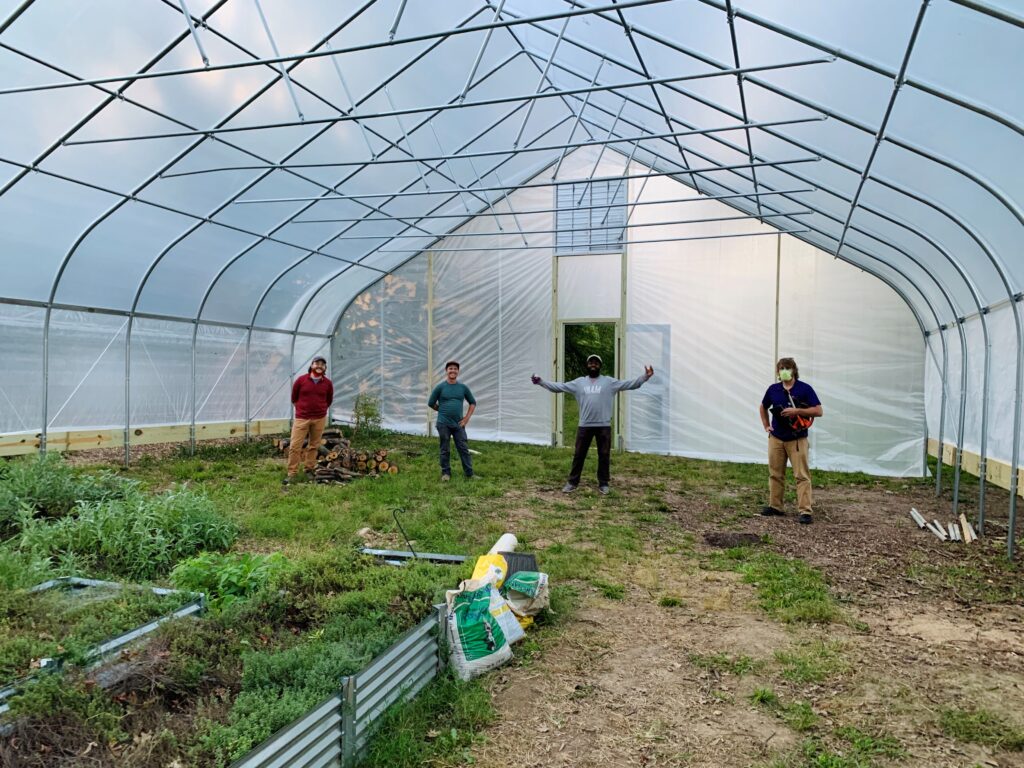
- High tunnels
- Low tunnels
- Raised beds
- Soil health practices (cover crop, reduced-till, crop rotations)
- Erosion control measures
- Pollinator plantings
- Compost facilities
- Improving irrigation efficiency
- Energy audits & efficiency improvements
CSP – Conservation Stewardship Program
CSP is a program that rewards farmers and landowners who are good stewards of their land and who wish to enhance their farming practices to take conservation to the next level. This is a 5 year program with a minimum annual payment of $4,000/year. Eligible participants must first meet a base level of stewardship; this is determined by a Resource Inventory assessment completed by a conservation planner. If met, the producer must also agree to install new conservation practices or enhancements on their farms that go above and beyond the current farming practices.
ELIGIBILITY:
In order to qualify for any of these federal programs you must meet the following eligibility requirements:
- Applicants must have an existing farm or garden operation producing agricultural products – there is no minimum sales requirement
- Individuals, businesses and non-profits are eligible to apply
- Must meet Adjusted Gross Income eligibility requirement (annual income of $900,000 or less)
- Government agencies and other government entities are not eligible.
- Producers can apply on private land and on state, federal or other government owned land if it is operated or managed by a nonprofit, business or individual.
In order to apply for federal programs please complete and submit this form. For additional questions reach out to your Conservation District and/or NRCS to schedule a site visit or call to further discuss your options.
Beginning Farmer Success Interview Series – Courtesy of University of Maryland Extension (UMDE) – November 2023
This series spotlights and celebrates Maryland farmers, industry professionals, and projects that aim to support Maryland agriculture and Beginning Farmer Success!
This month, we are featuring Colleen Kiefer, District Conservationist with the USDA Natural Resource Conservation Service (NRCS). Colleen agreed to speak with the Beginning Farmer Success Project about two programs scaled and available to small and urban farmers who want to incorporate or enhance conservation practices on their farm.
A: I went to undergraduate school and got a degree in natural resources. I graduated during the recession, and the only jobs available in Wisconsin were farmhand jobs on vegetable farms. So I did that for a while and eventually moved and started managing a farm in Upper Marlboro in Prince George’s County and did that for a few years. When the farm changed ownership, and it was time for me to find something new, I decided I wanted to have a larger impact. So, I started working with the Maryland Department of Agriculture as a conservation planner. I was there for about three years while working on my master’s degree in natural resource leadership. After my program, I could work with NRCS as a soil conservationist and then eventually moved into my current position as a district conservationist for Prince George’s County, Washington, D.C., and Baltimore City.
Q: Tell us about the programs that you administer.
A: The first program most people are familiar with is the EQIP program because it’s been around a little longer and has been more utilized. So, it is a reimbursement program that helps assist with the costs of installing conservation practices. High Tunnels are the most commonly known practice in the case of Urban EQIP, specifically for urban farms.
Still, we’ve also started bringing on a lot of other smaller-scale practices or practices that are better suited for urban farmers. This is our second year of offering raised beds as a practice. To quality, you need heavy metals in your soil or some impervious surface or rubble, which most of our urban farmers do. Raised beds have become our most popular practice this year. We have soil scientists on staff who come out and will do free heavy metal testing on all of those sites and a quick soil investigation to make sure that before we’re putting in the beds, they’re eligible, but then also to give them guidance on how to mitigate the effects and prevent any contamination to any crops that are being grown or if there are additional treatments, whether it be putting down lime or just simply putting down some barrier. We’re giving them all the guidance they need to correctly install their raised beds for their particular soil challenges.
We are offering low tunnels. So any hoop structure that’s four feet or less, and that can be with plastic, or it can be with insect netting or shade cloth. The nice thing about the low tunnel standard is they do not require landowner permission. So, a low tunnel is an excellent option if you can’t get landowner permission for a high tunnel.
We also are adopting some of our other standards for urban farms. We do heavy-use area protection, which we’re using primarily to help reduce erosion, but also increase Americans with Disability Act (ADA)accessibility —for example, putting gravel pads that are ADA accessible, especially between raised beds or in high tunnels. High tunnels must meet certain specifications, be six feet tall, have roll-up sides, and have a four-year manufacturer’s warranty.
We also can assist with roof runoff structures. So, if folks have pack sheds or even high tunnels causing erosion, we can help with drainage and guttering on those structures. There is a waiting list, but we offer micro-irrigation and can also help cover some of those costs. We also provide energy assistance on greenhouses, and Controlled Environmental Agriculture operations are eligible for energy audits and efficiency improvements. We assist and reimburse for pollinator plantings and several soil health practices. There are many more practices, but those are the most common for urban farms.
Q: Do you work with urban farms that include wooded areas they are managing on their land or incorporating with food forests?
A: We work with some urban forests, and they can get payments for things like brush management or invasive species removal and pollinator gardens with native species. You can do pollinator gardens through the EQIP or CSP program, depending on your goals. I will explain the CSP program in more detail in a moment.
Yes, suppose a farmer has adjacent wooded areas. In that case, they must own the land, or if they rent or have a use agreement, they will need permission from the landowner before implementing practices.
I do want to circle back to explain the CSP. It is more of a rewards-based program. So, how that program works is it’s a five-year program. We need to come out and do a site visit. We will do a resource inventory of the farmers’ conservation practices on their urban farms or community gardens. They’re typically eligible for that program if they meet a certain level of stewardship. From there, it’s a conversation about what kind of practices or enhancements they want. These are common practices that don’t necessarily have a large financial upfront cost.
So, in some cases, it’ll be adding pollinators to a crop rotation, like adding Sunflowers into a portion of a crop rotation or doing additional mulching to build soil health. There’s a minimum of $4,000 yearly payment for that program. So it’s a $20,000 minimum over five years. Likely, none of our urban farms will get more than that based on their size. But it’s still a significant amount of money. And the largest part of that payment is the reward portion of it. So you have some extra money that you can invest into the ongoing stewardship of your property as you choose, not necessarily specific to a particular practice we are contracting for. It’s an excellent program for urban farmers because of that minimum payment. And, if they are implementing annual practices, they don’t necessarily need that landowner’s permission.
Q: It can be hard to navigate what farmers need or don’t need permission for, particularly on urban land. Do you have any advice for farmers interested in your programs?
A: I know there’s a lot of information out there, but my role and the staff in our office is to walk farmers through every step of the paperwork and ensure it is filled out correctly. A large portion of the application contracting falls on us and not the applicant. They have to make decisions, and they have to sign things, and there is paperwork. Still, unlike financial programs or grants, there are not these extensive write-ups. We take on the majority of that role for them. So, it can seem daunting, but we walk farmers through every step of the process and make their applications as competitive as possible.
Q: What is the time frame from when somebody applies for one of these programs to them being implemented on their farm?
A: It varies. We accept applications year-round, so it slightly changes that timeline depending on when you apply. But typically, what happens in an average year, our application cycle end date for EQIP will be sometime between December and January. And then we’re looking at signing contracts anywhere from March to August. And it depends on the complexity of what is being requested. Suppose it’s something that requires an engineered design. In that case, unfortunately, there is a waiting list to get some of the bigger designs done, so that can hold things up. However, we are bringing in more staff, which will help. But we can address those requests annually as they come through for things like high tunnels, raised beds, and plantings.
For CSP, the timeframe is always a little bit delayed. It changes every year, but the application cycle’s end date is sometime in February, and we’re making those contracts and signing them a little bit later in the year, around July or early August.
Q: If our readers are interested in these programs, what is their next step?
A: Call and schedule a site visit. Even if they don’t necessarily have specific conservation goals, we can discuss options and determine their needs. Through the site visit and conversation, we can connect the dots, fill in any gaps, and lead them in the right direction for what they’re looking for and trying to accomplish. And it makes it simpler than trying to do a lot of online research, which can get pretty complicated, and our websites can get confusing.
We might find through some conversations that a farmer wants a high tunnel and needs to address climate resilience, which a high tunnel can help. Even though the weather might not be the primary lens that the farmers are looking at it through, it is part of the equation. Like the raised beds, they may not necessarily think about the toxins. However, if they are present, it is still a factor. Each farm is different, so everybody needs something different.
Our programs open up some doors to what these farmers are already doing, especially with the Conservation Stewardship Program; they’re already doing a lot of good stuff. These programs are generally built to reward them and then ask them to go a little above and beyond what they’re already doing.
Thank you. This information is helpful and affirming to farmers who are not quite sure what their conservation goals or needs are. Knowing that your team can come out and help them is a valuable service.
The Environmental Quality Incentives Program (EQIP) is for Urban/Suburban, Specialty Crops, Small Acreage, and Subsistence Operations. Learn more about the program and eligibility Here, and information on how to apply Here.
Click here for the full newsletter
|